
DeepDual Core
A native C++23 ecosystem for universal mathematical computation — beyond the real numbers, over arbitrary algebraic structures.
Overview
DeepDual Core is a native C++23 ecosystem for universal mathematical computation — built on a fundamental idea: differentiation, and mathematical computation more broadly, should not be tied to the real numbers.
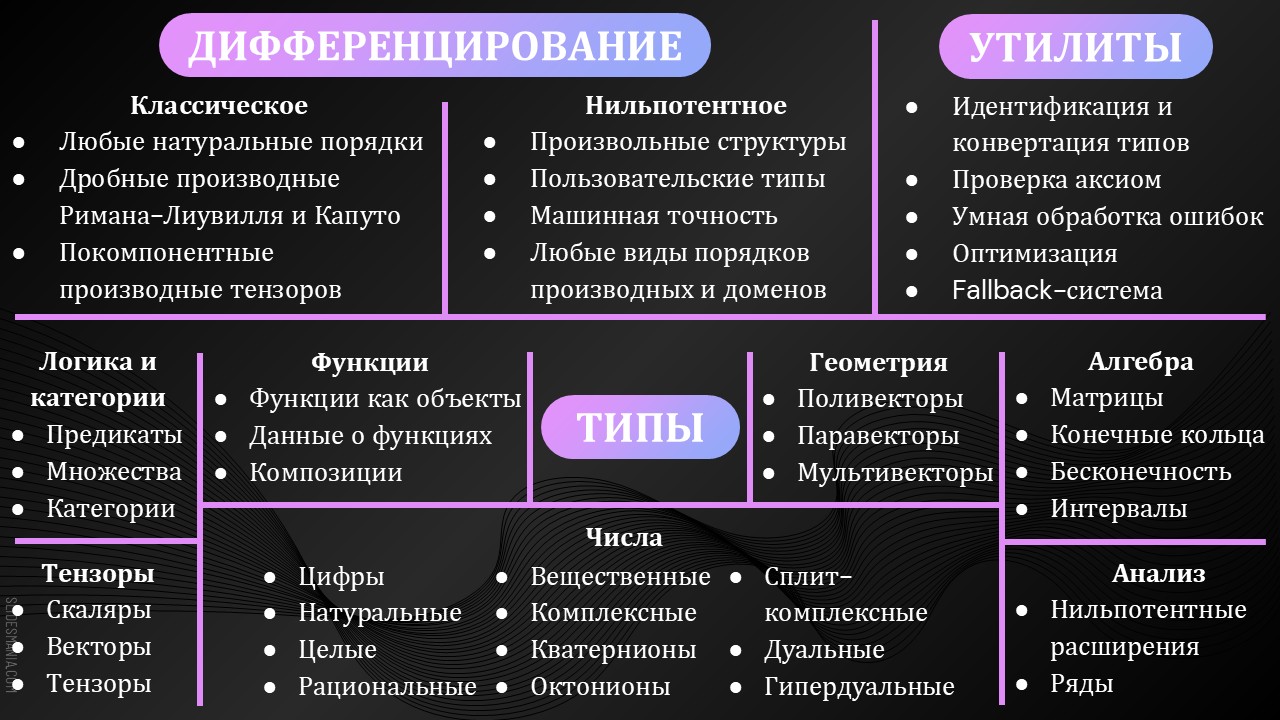
The ecosystem is organized into three layers:
- Utilities — numeric constants, function notations, fallback and expected-value handling, optimization tools.
- Types — numeric (rational, complex, quaternion, octonion, dual), geometric (polyvector, paravector, multivector), logical, and categorical.
- Differentiation — automatic differentiation over arbitrary algebraic structures, including hypercomplex numbers and geometric algebra, powered by Nilpotent Analysis.
By separating the what of a computation from the algebra it lives in, DeepDual Core lets the same algorithm be computed and differentiated across many numeric and geometric worlds, with structure-aware optimizations throughout.
Automatic differentiation in DeepDual Core is grounded in Nilpotent Analysis — a purely algebraic theory that defines derivatives without limits or topology, and that extends naturally to fractional, complex, and variable-order derivatives.
DeepDual Core is not a single-purpose library. It is a foundation for scientific computing, machine learning, physical modeling, and any domain where mathematics must move beyond the real numbers.
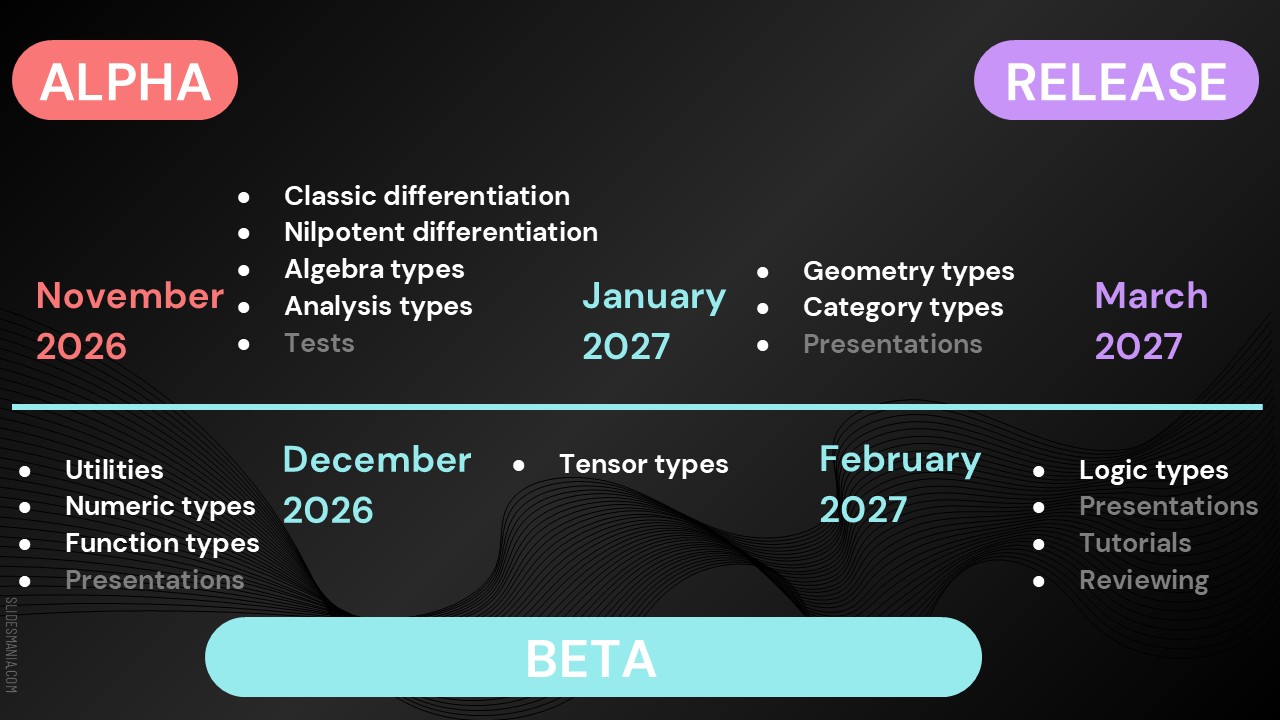
DeepDual Core Release will include
DIFFERENTIATION
Classic Differentiation
Nilpotent Differentiation
UTILS
TYPES
Logic Types
Category Types
Function Types
Numeric Types
Tensor Types
Algebra Types
Analysis Types
Geometry Types
MAY BE INCLUDED
Classic Differentiation
Category Types
Algebra Types
Tensor Types
Versions
- v0.1.0-pre-alphareleased on 26 May 2026
- v0.2.0-alphareleased on 18 October 2026
- v0.x.0-betaplanned in December 2026
- v1.0.0-releaseplanned in March 2027
Roadmap
Architecture
Key Features
Dual differentiation paradigms
A unique combination of classical heuristic differentiation (integer orders, Riemann-Liouville, Caputo, component-wise tensors) and universal algebraic nilpotent differentiation over arbitrary structures. Choose the tool that fits your mathematical foundation.
Nilpotent Analysis core
A purely algebraic theory of differentiation over arbitrary algebraic structures — including non-associative and non-commutative — without limits or topology.
Compile-time mathematical verification
Strict checks for type identification and mathematical axiom compliance (commutativity, associativity, identity, inverses) using C++20/23 concepts. Unsupported types are caught at compile time, not at runtime.
Predicates and sets
Predicates as first-class objects and object-oriented sets, including support for infinite sets via predicate-based element storage. A foundation for formal logic and category theory.
Arbitrary derivative orders
Derivatives of any order — from integer to fractional, from real to complex, from constant to variable. The order itself can be a user-defined type. This includes mixed partial derivatives of functions of several variables.
Category theory and formal logic
Objects, morphisms, concepts, unification, and normal forms as the backbone of the API.
Universal numeric types
Rational, complex, quaternion, octonion, dual, and hyperdual numbers, with support for rational exponents and rational derivative orders.
Infinite arithmetic
Extended real numbers with +∞, −∞, and Undefined states. Fully compatible with user-defined real types.
Finite rings and fields
Cyclic arithmetic on discrete structures {0, 1, …, n − 1} with characteristic n. Differentiation is fully supported via nilpotent analysis, proving that calculus does not require continuity.
Interval arithmetic
Rigorous bounded and unbounded intervals with a dedicated undefined-state flag. Supports arithmetic operations and elementary functions without silent numerical errors.
Tensor and vector algebra
Scalars, vectors, and matrices over arbitrary fields. Linear algebra independent of the underlying field type.
Geometric algebra
Polyvectors, paravectors, and multivectors for structure-aware calculus.
Analytic series as objects
Infinite sums and products as lazy objects with configurable bounds (finite or infinite) and a user-defined term generator. Supports truncation, term extraction, and convergence checking.
Functions as objects
Storing, composing, and passing functions as first-class values — a foundation for higher-order operations, functional composition, and symbolic manipulation.
User-defined types
Any algebraic structure that satisfies the axioms can be used as a numeric type — both in functions and in derivative orders.
Zero-overhead error handling
Native std::expected integration with dedicated error types, eliminating the need for mandatory string-based exceptions and ensuring zero runtime overhead for the happy path.
Fallback system
A structure-aware fallback mechanism that extends supported operations to user-defined types without requiring them to implement every interface.
Built-in optimizations
Thread pool, caching, and parallel computation integrated into the kernel.
Conversion utilities
Compile-time checks for the existence of constructors and converters between types, enabling safe and consistent interaction between user-defined and built-in types.